


ROYAL CHAOS · June 20, 2026
Marie Antoinette: Did She Really Say “Let Them Eat Cake”?
Marie Antoinette is famous for allegedly telling starving French peasants to “let them eat cake.” The problem? She almost certainly never said it. So how did one sentence turn her into history’s most infamous queen?
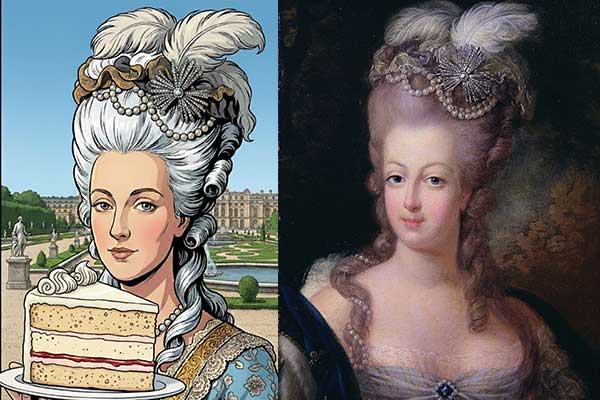
Marie Antoinette became one of the most hated figures of the French Revolution. She was portrayed as extravagant, uncaring, and completely disconnected from ordinary French people. The most famous story about her is the phrase "Let them eat cake," supposedly her response when told that the poor had no bread. There is just one problem: there is no solid evidence that Marie Antoinette ever said it. The real story is stranger, and considerably more complicated. Read more odd histories
Who was Marie Antoinette?
Marie Antoinette was born in Vienna in 1755 as the youngest daughter of Empress Maria Theresa of Austria. At just 14 years old, she was married to Louis-Auguste, the future King Louis XVI of France, as part of an alliance between Austria and France.
She arrived at the French court as a teenager and eventually became queen in 1774. The French monarchy was already facing serious financial problems, political tensions, and growing criticism. Marie Antoinette quickly became one of the most visible symbols of the royal court.
She was young, foreign-born, extremely wealthy, and living inside one of the most extravagant courts in Europe. That combination made her an easy target for public anger, whether or not every accusation against her was true.
So where did “Let them eat cake” come from?
The famous quote is usually presented as Marie Antoinette’s response to hearing that French peasants had no bread. According to the story, she supposedly said, “Let them eat cake.” It is a perfect quote for a revolution: short, cruel, and almost cartoonishly out of touch.
The problem is that the phrase appeared in print before Marie Antoinette was even queen, and there is no reliable evidence that she said it.
The earliest famous version comes from the autobiography of Jean-Jacques Rousseau. In his Confessions, written during the 1760s and 1770s, Rousseau described a “great princess” who supposedly responded to the lack of bread by suggesting that people eat brioche instead.
Rousseau did not name Marie Antoinette. She was still a child when he wrote the passage, making it extremely unlikely that the story originally referred to her.
Read more about her life in Marie Antoinette: A Life From Beginning to End (French Revolution).
Wait... what does “cake” actually mean?
There is another problem with the English version. The original French phrase was “Qu’ils mangent de la brioche,” which is closer to “Let them eat brioche.” Brioche is a rich, buttery bread, not cake in the modern English sense.
The phrase also refers to a legal concept sometimes called the “retort to bread.” If ordinary bread was unavailable, people could theoretically use a more expensive type of bread instead. The story was meant to illustrate absurd privilege, not necessarily a queen literally suggesting birthday cake to starving peasants.
Translation did the rest. “Let them eat cake” is shorter, punchier, and considerably more memorable. History, apparently, also has a branding department.
Why did people hate Marie Antoinette?
Marie Antoinette was already deeply unpopular before the French Revolution. Her spending habits, friendships, fashion, and involvement in court politics were frequently attacked in pamphlets and newspapers.
She became known by the nickname “Madame Déficit,” with critics blaming her extravagant lifestyle for France’s financial problems. In reality, the French financial crisis was much larger than the spending of one queen. France had accumulated enormous debts through wars, including its intervention in the American Revolutionary War.
That did not stop Marie Antoinette from becoming a convenient symbol of royal excess. Her reputation was also attacked through increasingly vicious political propaganda, including obscene and defamatory pamphlets portraying her as sexually immoral and corrupt.
Whether the accusations were true mattered less than the fact that people were willing to believe them. By the late 1780s, Marie Antoinette had become one of the most hated members of the French royal family.
The French Revolution changes everything
In 1789, France entered a political and economic crisis that quickly turned into revolution. The Estates-General was called, the Bastille was stormed, and the authority of the monarchy began collapsing.
Marie Antoinette and Louis XVI attempted to maintain their position, but the royal family became increasingly trapped by revolutionary politics. In October 1789, thousands of protesters marched to Versailles and forced the royal family to move to Paris.
The queen was now living under intense public scrutiny. Her Austrian background also made her especially unpopular, and revolutionaries increasingly portrayed her as an enemy of France.
The queen tries to escape
In June 1791, the royal family attempted to escape Paris and reach territory controlled by royalist forces. The plan was to leave secretly and eventually regain enough political freedom to resist the Revolution.
It went spectacularly badly.
The family was recognized and arrested at Varennes before reaching safety. They were escorted back to Paris, and the failed escape severely damaged what remained of public trust in the monarchy.
The escape attempt also became politically explosive because revolutionaries could now portray the king and queen as actively working against the Revolution rather than simply being powerless figures caught in events.
From queen to prisoner
In 1792, the French monarchy was abolished and the royal family was imprisoned. Louis XVI was eventually tried and executed by guillotine in January 1793.
Marie Antoinette remained imprisoned for several more months. In October 1793, she was brought before the Revolutionary Tribunal and charged with crimes including treason.
She was found guilty and sentenced to death. On 16 October 1793, Marie Antoinette was taken through Paris in an open cart and executed by guillotine.
So did Marie Antoinette actually say it?
Almost certainly not, based on the surviving evidence. The famous “Let them eat cake” story cannot be reliably traced to Marie Antoinette, and the earliest known version predates her time as queen.
That does not mean Marie Antoinette was universally beloved or that criticism of the French monarchy was invented. France had real economic problems, severe inequality, political instability, and widespread anger toward the royal court.
But turning all of that into one sentence supposedly spoken by a teenage queen gives us a much simpler story than the historical reality. It also made Marie Antoinette into the perfect villain for generations of retellings.
The quote survived because it was useful, memorable, and perfectly matched the image people already had of her. Sometimes history does not need a good line to be true. It just needs a good line.
Why the myth survived
Marie Antoinette’s reputation continued to change long after her death. Later writers, artists, filmmakers, and political commentators repeatedly returned to the image of the glamorous queen who supposedly could not understand ordinary people.
The “Let them eat cake” story became shorthand for extreme wealth and political disconnection. It was much easier to remember than the complicated financial crisis, political conflicts, and social tensions that helped cause the French Revolution.
The irony is that Marie Antoinette probably never said the words that became her most famous quotation. Yet the sentence became so closely associated with her that correcting the story has never quite managed to kill it.
So the next time someone tells you Marie Antoinette looked at starving people and casually suggested cake, remember: the queen probably did not say it. History simply decided that she would.
The real story is stranger
Marie Antoinette was neither the cartoon villain of revolutionary propaganda nor simply an innocent victim of history. She was a young queen caught inside a collapsing political system, surrounded by enormous wealth, intense public resentment, and increasingly violent revolutionary politics.
The “Let them eat cake” story tells us more about how historical myths are created than about what Marie Antoinette actually said.
A sentence attributed to the wrong person became one of the most famous quotations in history. Not bad for something she probably never said.
For more of history's funniest and strangest moments, read more odd histories.
More odd stories
Back to the archive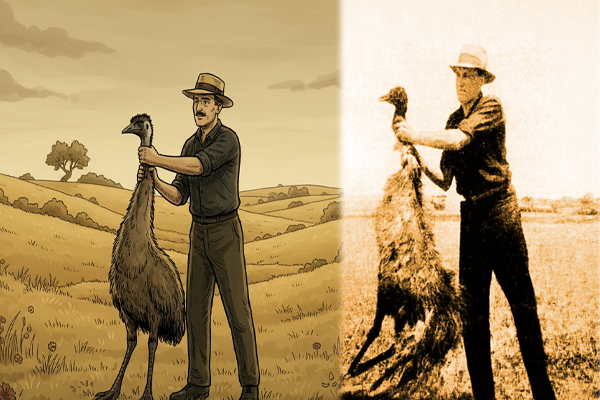
The Great Emu War of 1932: Australia vs. the Emus
In 1932, Australia sent soldiers armed with Lewis guns to deal with thousands of emus destroying wheat crops in Western Australia. The result became one of the strangest military operations in history.
Read the storyThe woman who built a clockwork duck
In 1739, a French inventor unveiled a mechanical bird that could eat, flap, and make everyone deeply uncomfortable.
Read the storyWhen a town put a fish on trial
A very serious courtroom. A very slippery defendant. The medieval world had a way with civic drama.
Read the story